
Attending to Remember
How the Rhythm of Our Focus Shapes Our Memories

We’ve all been there. You walk into a room and suddenly stop, paralyzed by a simple, frustrating question: Why did I come in here? Or perhaps you are driving, intent on finding a specific street sign, only to have a dog run out between parked cars, shattering your focus.
These moments highlight the delicate dance between two fundamental cognitive forces: attention and episodic memory.
In a recent paper published in Current Directions in Psychological Science, my colleagues and I explore this intersection. Titled "Attending to Remember: Recent Advances in Methods and Theory," we dive into the latest cognitive neuroscience research revealing how the quality of our attention – down to the millisecond – dictates whether we learn and remember, or whether those moments slip away [1].
Here is a brief look at the core concepts we cover in the article, and what they tell us about the human mind, learning, and remembering.

Two Sides of Attention
To understand memory, we first have to look at how we attend to the world. In the article, we highlight a long-argued dichotomy between top-down and bottom-up attention.
Top-down attention is goal-directed. It’s the mental spotlight you turn on when you are scanning for that specific street name.
Bottom-up attention is stimulus-driven. It’s what happens when that dog runs into the street – your attention is captured by the unexpected event.
Though, it’s critical to emphasize that these systems don’t work in isolation. Rather, they interact dynamically with our goals. In the article, we highlight that the interactions between these attention networks and our memory systems are bidirectional: not only do our goals influence where we focus our spotlight of attention, but what we attend to also reshapes our goals.
Readiness to Learn and Remember
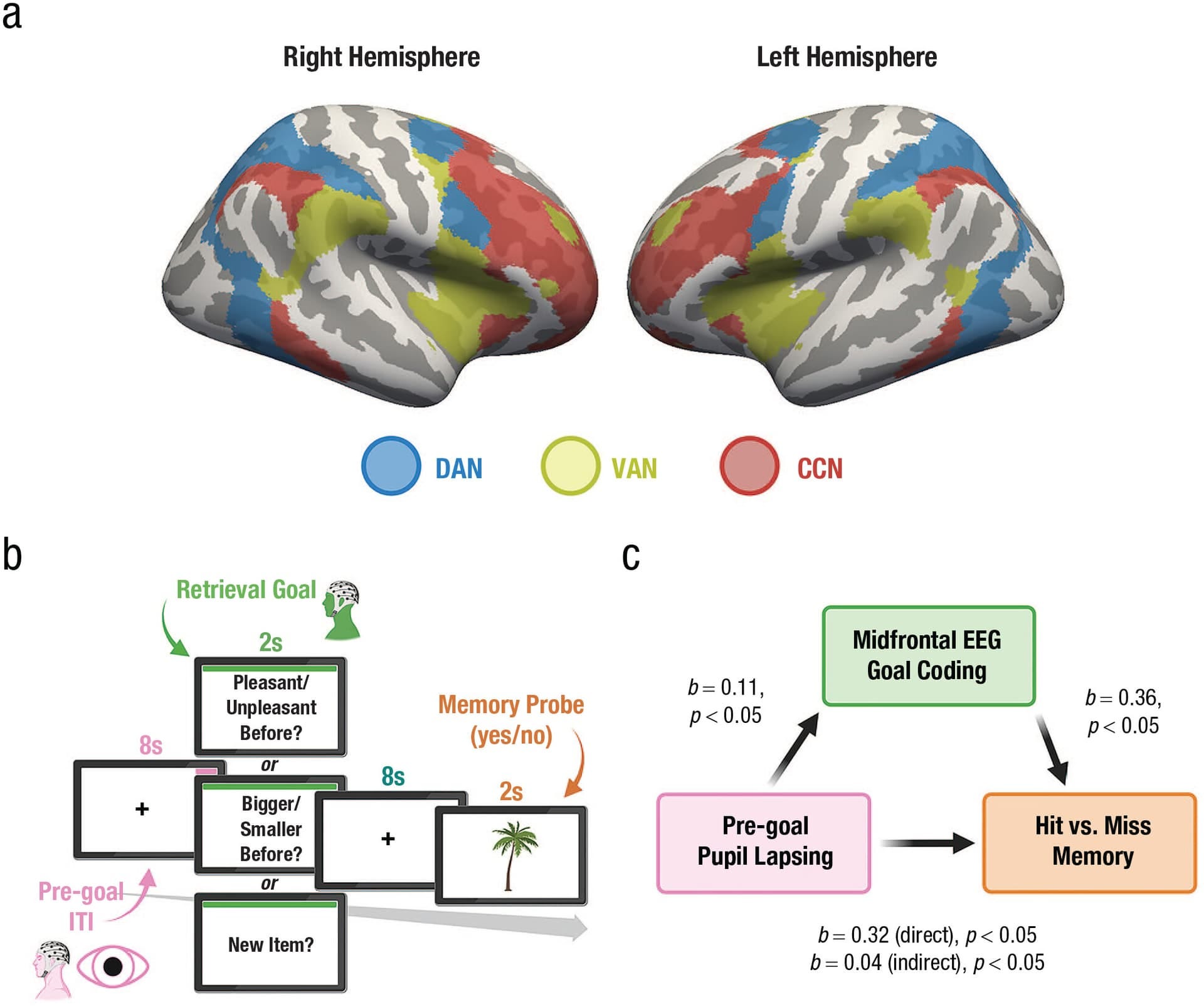
One of the most exciting developments in our field is the ability to measure a person’s “readiness” to learn or remember before they even see the information or express their memory for the information [2].
Using psychophysiological tools like pupillometry (measuring pupil diameter) and scalp EEG (tracking electrical brain activity), we can now see that the state of your brain just prior to an event predicts memory success. For example, prior work from our lab on goal-directed memory published in Nature revealed that the size of a participant's pupil—and their brain’s posterior alpha power — in the 1-second period just prior to receiving a retrieval goal predicted whether they would successfully remember the item associated with that goal in a prior learning phase [3].
In other words, we can think of sustaining attention as more than just a switch you flip on and off; rather, it’s a fluctuating state that prepares an individual for successful acquisition and expression of knowledge.
The Rhythm of the Mind
Perhaps the most counterintuitive finding we discuss is that attention and memory are rhythmic.
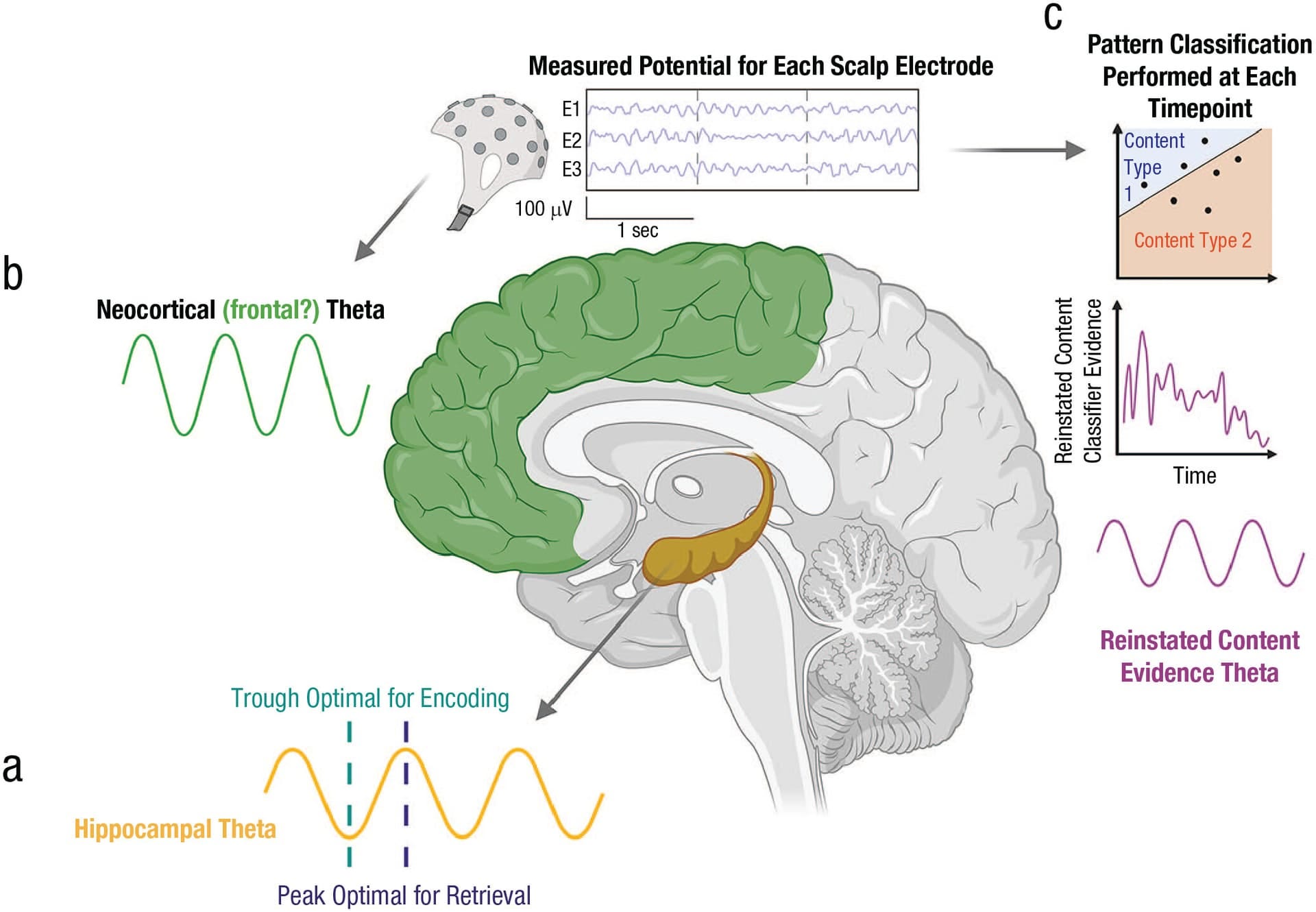
Research suggests that attention samples the world in cycles, oscillating roughly in the theta (4–7 Hz) and alpha (8–12 Hz) frequency ranges. Think of it less like a continuous beam of light and more like a strobe light. There are “optimal” phases of this rhythm where we are primed to process information, and “sub-optimal” phases where we are less receptive.
This raises a fascinating question we explore in the paper: Does memory encoding and retrieval depend on the phase of this rhythm?
Recent evidence supports the "Separate Phases of Encoding and Retrieval" (SPEAR) model [4]. The theory posits that the hippocampus (the brain’s memory hub) might switch between processing modes—taking in new information (encoding) versus generating internal predictions (retrieval)—in sync with these theta rhythms. We are beginning to see that the strength of memory representations in the neocortex actually oscillates, perhaps governed by these attentional clocks.
Aging and the Precision of Memory
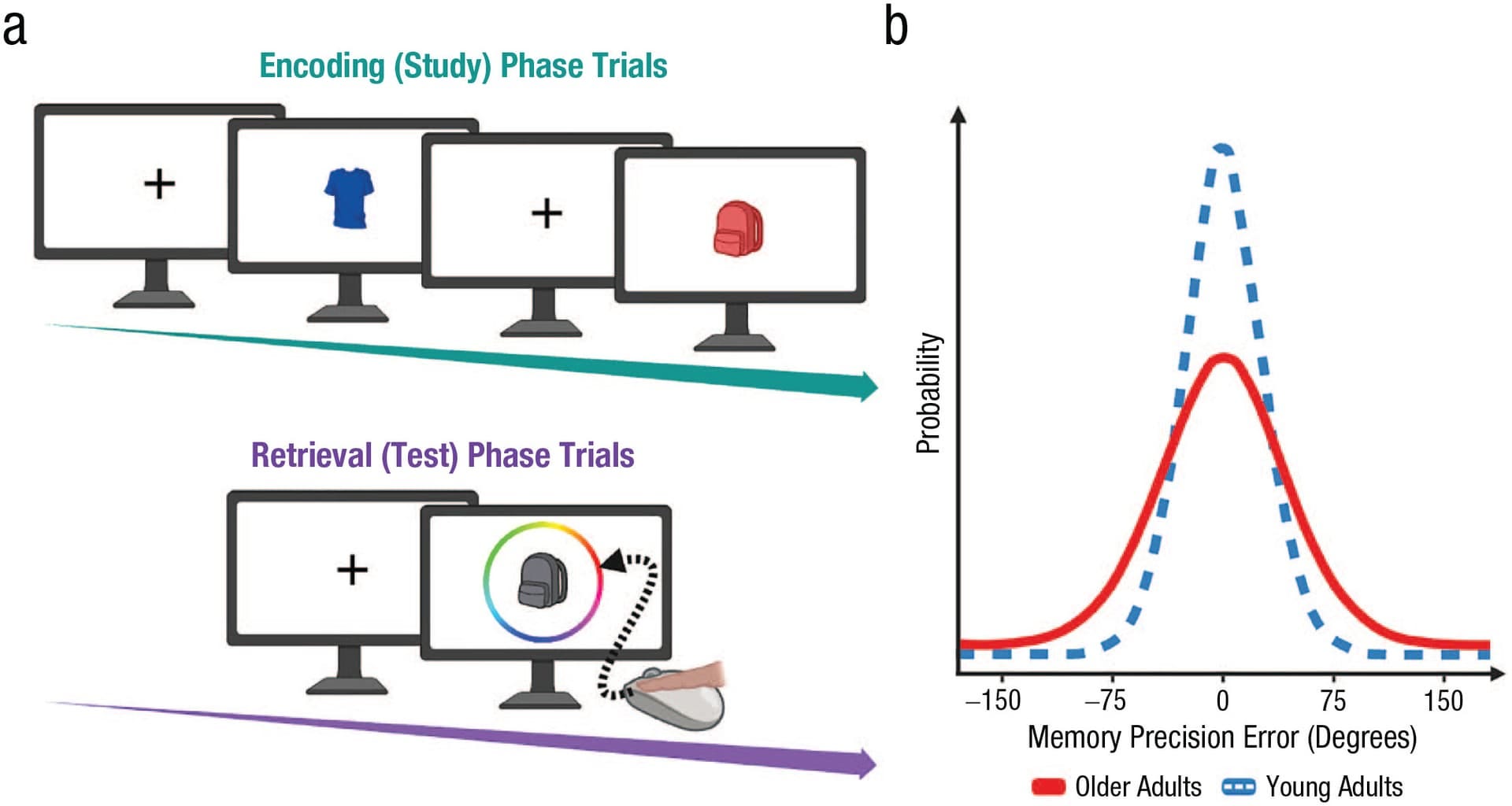
As we age, our memory changes. But we argue that looking at simple “hit or miss” rates (did you remember the item or not?) misses the nuance. We need to look at memory precision.
In the article, we discuss paradigms where participants must remember continuous features, like the exact shade of a color on a 360-degree wheel [5].
Older adults often show a decline in this precision. This "blurring" of memory might be linked to neural dedifferentiation—a reduction in the selectivity of neural activity [6].
Crucially, this decline in precision seems partially attributable to changes in attention. When older adults are given cues to guide their attention, the gap in performance between them and younger adults narrows. This suggests that keeping our memories sharp is, in part, about maintaining the ability to filter and focus.
The Future: Closed-Loop Science
Finally, we look toward the horizon of closed-loop experiments.
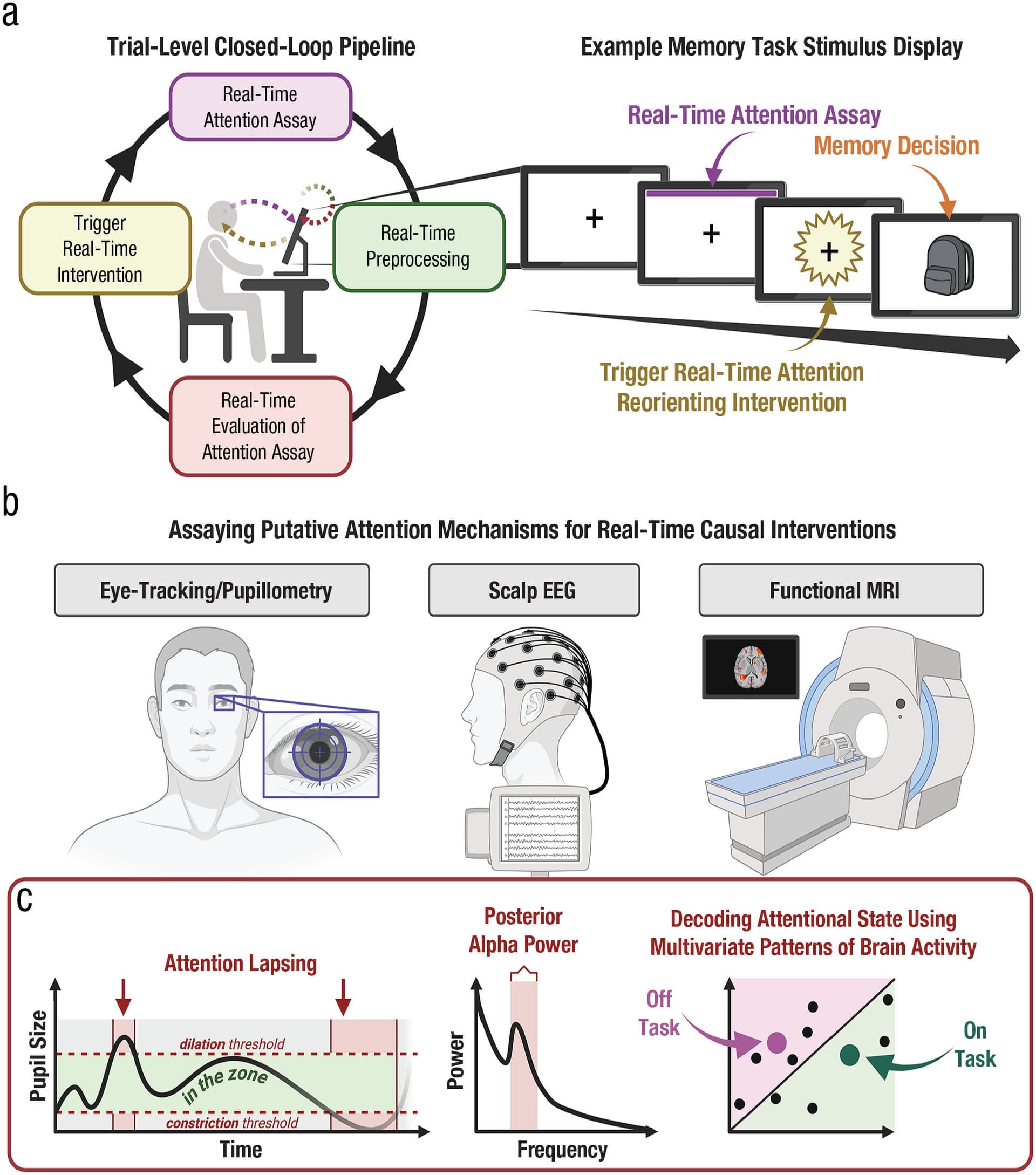
Historically, we’ve relied on correlations—observing that when attention is high, memory is good. But new technology allows us to intervene in real-time. By monitoring a person’s brain state or pupil size millisecond-by-millisecond, we can trigger memory tasks exactly when the brain is in an “optimal” or “sub-optimal” state.
Imagine a system that detects when your attention is lapsing and waits to present crucial information until you are back “in the zone.” This approach promises to move us from simply observing these relationships to demonstrating the causal links between how we attend and how we remember.
Final Thoughts
This paper represents a synthesis of where the field stands and where it is going. By understanding the mechanisms of attention—its rhythms, its neural signatures, and its role in aging—we get closer to understanding the machinery of our own minds.
You can read the full peer-reviewed article here: Attending to Remember: Recent Advances in Methods and Theory.
Stay tuned for more updates on the science of sustained attention.
References
Schwartz, S.T., et al. (2025). Attending to remember: Recent advances in methods and theory. Current Directions in Psychological Science, 34(6), 330-341. Retrieved from https://doi.org/10.1177/09637214251339452
Madore, K.P., & Wagner, A.D. (2022). Readiness to remember: predicting variability in episodic memory. Trends in Cognitive Sciences, 26(8), 707-723. Retrieved from https://doi.org/10.1016/j.tics.2022.05.006
Madore, K.P., et al. (2020). Memory failure predicted by attention lapsing and media multitasking. Nature, 587(7832), 87-91. Retrieved from https://doi.org/10.1038/s41586-020-2870-z
Hasselmo, M.E., Bodelon, C. & Wyble, B.P. (2002). A proposed function for hippocampal theta rhythm: separate phases of encoding and retrieval enhance reversal of prior learning. Neural Computation, 14(4), 793-817. Retrieved from https://doi.org/10.1162/089976602317318965
Sutterer, D.W., & Awh, E. (2016). Retrieval practice enhances the accessibility but not the quality of memory. Psychonomic Bulletin & Review, 23(3), 831-841. Retrieved from https://doi.org/10.3758/s13423-015-0937-x
Sheng, J., Trelle, A.N., Romero, A., Park, J., Tran, T.T., Sha, S.J., Andreasson, K.I., Wilson, E.N., Mormino, E.C., & Wagner, A.D. (2025). Top-down attention and Alzheimer’s pathology affect cortical selectivity during learning, influencing episodic memory in older adults. Science Advances, 11(24). Retrieved from https://doi.org/10.1126/sciadv.ads4206